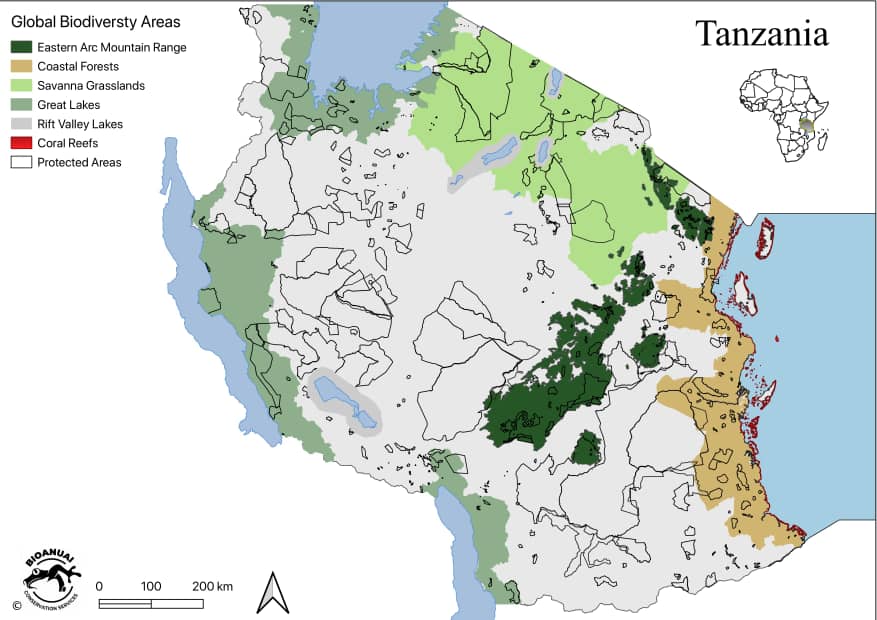
This map illustrates why Tanzania is recognized as one of the world's most significant biodiversity hotspots. The country's unique geography, which includes a vast coastline, massive inland lakes, and dramatic mountain ranges, has created a mosaic of distinct ecosystems, each hosting a wealth of unique flora and fauna.
Here is a breakdown of the key biodiversity areas highlighted on the map:
1. Eastern Arc Mountain Range
Home to unique species like the Udzungwa red colobus monkey, the Kipunji monkey (one of
the most endangered primates in the world), and hundreds of endemic plant and reptile
species.
2. Coastal Forests
These forests are a critical component of the "Coastal Forests of Eastern Africa" biodiversity
hotspot. Like the Eastern Arc, they host many endemic species but are under extreme threat
from agricultural expansion and logging.
3. Savanna Grasslands
These are grasslands support the most spectacular concentrations of large mammals on Earth,
including the Great Migration of wildebeest and zebra across the Serengeti.
The Serengeti ecosystem, Tarangire National Park, and the Ngorongoro Conservation Area. Key
species include lions, elephants, cheetahs, wildebeest, and giraffes.
4. Great Lakes
Tanzania is bordered by three of Africa's Great Lakes (Victoria, Tanganyika, Nyasa)
and contains numerous Rift Valley soda lakes (e.g., Manyara, Natron, Eyasi).
Lake Tanganyika: The worlds second-largest and second-deepest
freshwater lake, renowned for its extraordinary diversity of unique cichlid fish.
Lake Victoria: Africa largest lake by area.
Rift Valley Soda Lakes: These alkaline lakes provide critical breeding grounds for millions of
flamingos (Lesser Flamingo at Lake Natron).
5. Coral Reefs.
These reefs are part of the vibrant Western Indian Ocean marine biodiversity hotspot. They
provide critical habitat for countless fish, sea turtles, and marine invertebrates, support local
fisheries, and protect coastlines from erosion. The Mafia Island Marine Park is one of the most
important marine protected areas in the region.
6. Protected Areas
National Parks, Game Reserves, and Forest Reserves network are the cornerstone of Tanzania's
conservation strategy: safeguarding ecosystem for tourism, scientific research, and the
preservation of ecosystem services.